
Introduction
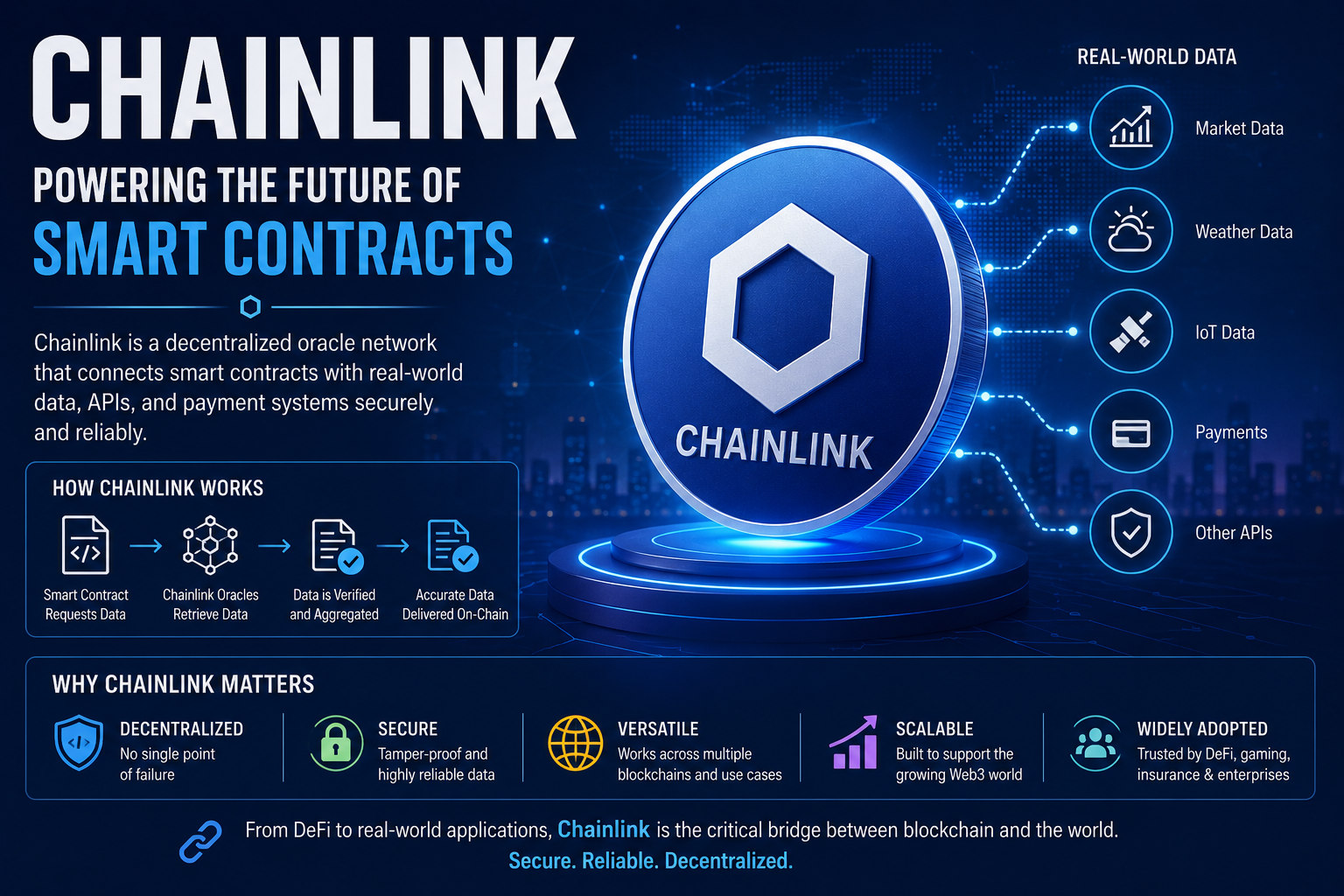
Blockchain technology has changed the way people think about finance, digital ownership, and decentralized systems. Yet one major challenge has always existed: blockchains can’t easily access real-world information on their own. That’s where chainlink comes in. Chainlink is a decentralized oracle network designed to connect smart contracts with external data sources, APIs, and payment systems in a secure and reliable way.
As decentralized finance (DeFi), NFTs, and blockchain applications continue to grow, Chainlink has become one of the most important infrastructure projects in the crypto space. Its native token, LINK, supports the network and incentivizes accurate data delivery. From crypto price feeds to weather data and sports results, Chainlink helps blockchain applications interact with the real world. In this article, we’ll explore how Chainlink works, why it matters, its advantages, use cases, and what the future may hold for this innovative blockchain technology.
What Is Chainlink and Why Is It Important?
Chainlink is a decentralized oracle network that allows blockchain smart contracts to securely communicate with data outside the blockchain. In simple terms, it acts as a bridge between blockchain networks and real-world information.
Smart contracts are powerful because they automatically execute agreements without middlemen. However, blockchains themselves are isolated systems. They cannot directly access information like stock prices, weather reports, or sports scores. Chainlink solves this problem by providing trusted data feeds through decentralized oracles.
The project was launched by Sergey Nazarov and has become one of the leading blockchain infrastructure solutions in the cryptocurrency industry. Its native token, LINK, is used to reward node operators who provide accurate and reliable data.
One reason Chainlink stands out is its decentralized structure. Instead of relying on a single source of information, Chainlink gathers data from multiple providers. This reduces the risk of manipulation, inaccurate reporting, or system failures.
Chainlink is especially important in decentralized finance. Many DeFi platforms depend on accurate price feeds for lending, borrowing, and trading. Without secure oracle systems, smart contracts could malfunction or become vulnerable to attacks.
As blockchain adoption grows, the need for reliable external data continues to increase, making Chainlink a key part of the expanding crypto ecosystem.
How Chainlink Oracles Work
To understand Chainlink, it’s important to know what an oracle is. In blockchain technology, an oracle is a service that supplies external information to smart contracts. Chainlink improves this process by decentralizing the oracle system.
When a smart contract requests data, Chainlink sends the request to multiple independent oracle nodes. These nodes collect information from APIs, databases, or other real-world sources. The network then compares and verifies the results before delivering the final data to the blockchain.
This decentralized method improves accuracy and security. If one data source fails or provides incorrect information, the network can still rely on the remaining sources. This makes Chainlink more trustworthy than centralized oracle systems.
Chainlink oracles can provide many types of information, including cryptocurrency prices, market statistics, weather conditions, election results, and sports scores. The flexibility of the network allows developers to build advanced decentralized applications across different industries.
The network also supports automation services known as Chainlink Keepers. These tools help smart contracts execute tasks automatically when certain conditions are met. For example, a DeFi platform could automatically liquidate collateral when asset prices fall below a specific threshold.
Another major innovation is Chainlink’s Cross-Chain Interoperability Protocol (CCIP), which aims to improve communication between different blockchain networks. As the blockchain industry moves toward interoperability, Chainlink may play a central role in connecting ecosystems together.
Real-World Uses of Chainlink Technology
Chainlink is widely used across the blockchain industry because it enables smart contracts to interact with real-world data securely. One of the most common use cases is decentralized finance. DeFi platforms rely heavily on accurate price feeds for lending protocols, decentralized exchanges, and derivatives trading.
For example, a lending platform needs updated cryptocurrency prices to determine collateral value. Chainlink provides these live market feeds, helping reduce the risk of inaccurate pricing and liquidation errors.
Chainlink is also becoming important in the insurance industry. Smart contracts can automatically process claims based on real-world events. Weather insurance, for instance, can use Chainlink data feeds to trigger payouts when droughts, floods, or storms occur.
The gaming and NFT sectors are also exploring Chainlink technology. Blockchain games can use verifiable random functions (VRF) provided by Chainlink to ensure fair gameplay and random rewards. NFT projects may use external data to create dynamic digital assets that change based on real-world events.
Enterprises and traditional businesses are beginning to explore oracle technology as well. Chainlink can help businesses securely connect blockchain applications with existing systems and databases.
As blockchain adoption expands into finance, healthcare, logistics, and supply chains, reliable oracle networks are becoming essential. Chainlink’s growing list of partnerships and integrations highlights its increasing influence across multiple industries.
Advantages and Challenges of Chainlink
Chainlink offers several advantages that have helped it become a leading blockchain infrastructure project. One of its biggest strengths is decentralization. By collecting data from multiple sources, the network reduces the risk of single points of failure and improves reliability.
Security is another major advantage. Chainlink’s oracle system is designed to protect smart contracts from inaccurate or manipulated data. This is especially important in DeFi applications where even small pricing errors can cause major financial losses.
Scalability and flexibility also contribute to Chainlink’s success. Developers can integrate oracle services into many types of decentralized applications, from finance to gaming and enterprise software.
Another important benefit is interoperability. Chainlink is designed to work across multiple blockchains, including Ethereum, Solana, and BNB Chain. This broad compatibility increases its usefulness within the crypto ecosystem.
Despite its strengths, Chainlink faces some challenges. Competition in the oracle sector continues to grow as new blockchain projects develop alternative solutions. Maintaining dominance will require constant innovation and network expansion.
Another challenge is market volatility. Like most cryptocurrencies, LINK token prices can experience dramatic fluctuations, which may affect investor sentiment.
Complexity can also be a barrier for newcomers. Oracle systems and smart contract infrastructure are more technical than standard cryptocurrency transactions, making adoption slower among casual users.
Still, Chainlink’s strong reputation and widespread integration continue to make it one of the most trusted oracle solutions in blockchain technology.
The Future of Chainlink and LINK Token
The future of Chainlink looks promising as blockchain technology continues to evolve. Smart contracts are expected to become more advanced and widely adopted, increasing the demand for reliable oracle services.
One area of growth is decentralized finance. As DeFi platforms expand globally, accurate and secure data feeds will remain essential. Chainlink’s established presence gives it a strong advantage in this rapidly growing market.
Cross-chain communication is another exciting development. The Cross-Chain Interoperability Protocol could allow different blockchain ecosystems to share information and assets more efficiently. This would improve connectivity and reduce fragmentation across the crypto industry.
Institutional adoption may also boost Chainlink’s growth. Banks, enterprises, and governments exploring blockchain technology may require secure oracle networks to connect real-world data with decentralized systems.
The LINK token itself plays an important role in the ecosystem. Node operators are rewarded with LINK for providing accurate data services, and future staking features may strengthen network security even further.
As blockchain applications become more integrated into everyday life, Chainlink’s role as a trusted data provider could become increasingly valuable. While challenges and competition remain, many analysts and developers believe Chainlink will continue to be a foundational part of the decentralized web.
Conclusion
Chainlink has become one of the most essential infrastructure projects in blockchain technology by solving a major problem: connecting smart contracts with real-world data. Through its decentralized oracle network, Chainlink enables secure communication between blockchain applications and external information sources.
From DeFi and NFTs to gaming and enterprise systems, Chainlink supports a wide range of innovative blockchain use cases. Its focus on security, decentralization, and interoperability has helped establish it as a trusted solution in the crypto industry.
As the blockchain ecosystem continues to expand, chainlink is likely to remain a critical technology powering the next generation of smart contracts and decentralized applications.
FAQs
What is Chainlink used for?
Chainlink is used to connect blockchain smart contracts with external data sources such as price feeds, APIs, and real-world information.
What is the LINK token?
LINK is the native cryptocurrency of the Chainlink network. It is used to reward node operators and support oracle services.
Why are Chainlink oracles important?
Chainlink oracles provide accurate and secure external data to smart contracts, helping decentralized applications function properly.
Is Chainlink part of Ethereum?
Chainlink is not part of Ethereum, but it works closely with Ethereum and many other blockchain networks.
Can Chainlink be used outside crypto?
Yes, Chainlink technology can support industries such as insurance, supply chains, gaming, and enterprise data management.
 admin
admin